 Pawel M. Konefal
AI & development ·
Agents working while I sleep
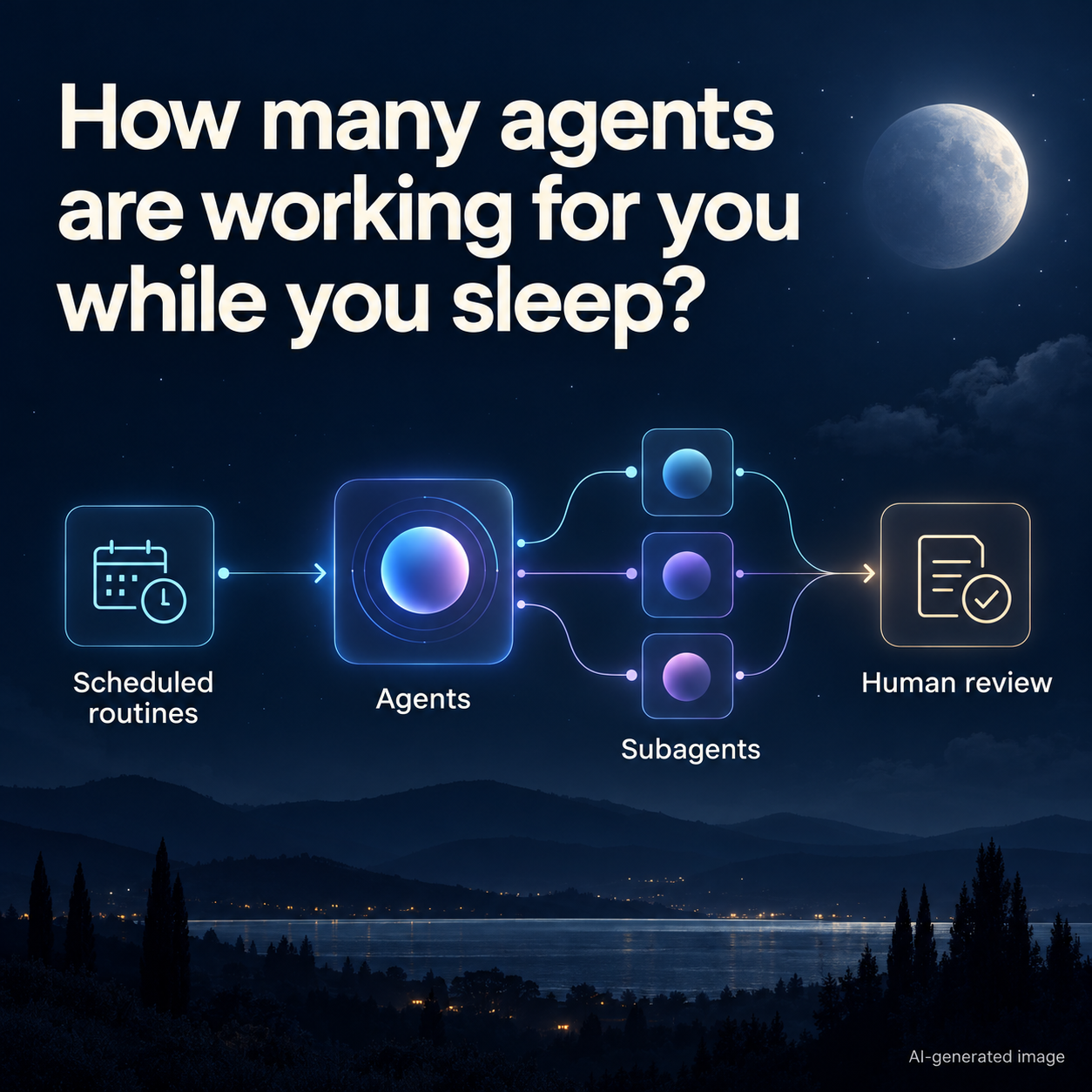
How many agents are working for you while you sleep?
Scheduled routines are a big part of my agent setup.
I define recurring tasks in advance and schedule when they should run. When a routine is due, an agent can start within that agreed scope without waiting for another prompt from me.
Alongside those routines, I delegate individual tasks to agents that work asynchronously while I do something else.
Depending on the model and agent setup, an agent can also spawn subagents automatically to work on parts of a task in parallel.
Some of that work can happen while I’m asleep.
For each routine, the setup needs to answer a few questions:
- When should it run, and how often?
- What should the agent achieve, and what counts as done?
- Which context does it need, and where can it find it?
- What is it allowed to do, and when must it stop for my approval?
- Can it delegate to subagents, and within which limits?
- Where should it save the result, and when should it notify me?
Shared context gives the agents a starting point. Explicit permissions set the boundaries. If the next action needs a new decision from me, it waits. A scheduled run doesn’t grant additional authority.
Command guardrails connected through hooks add a technical check for certain shell commands. Reviewing the output remains part of my job.
When I come back, I want a result I can inspect, a clear status or a specific question that needs my input.
I treat autonomy as a set of specific permissions—and scheduled routines make those permissions useful over time.
How many agents are working for you while you sleep—and what are they actually allowed to do?